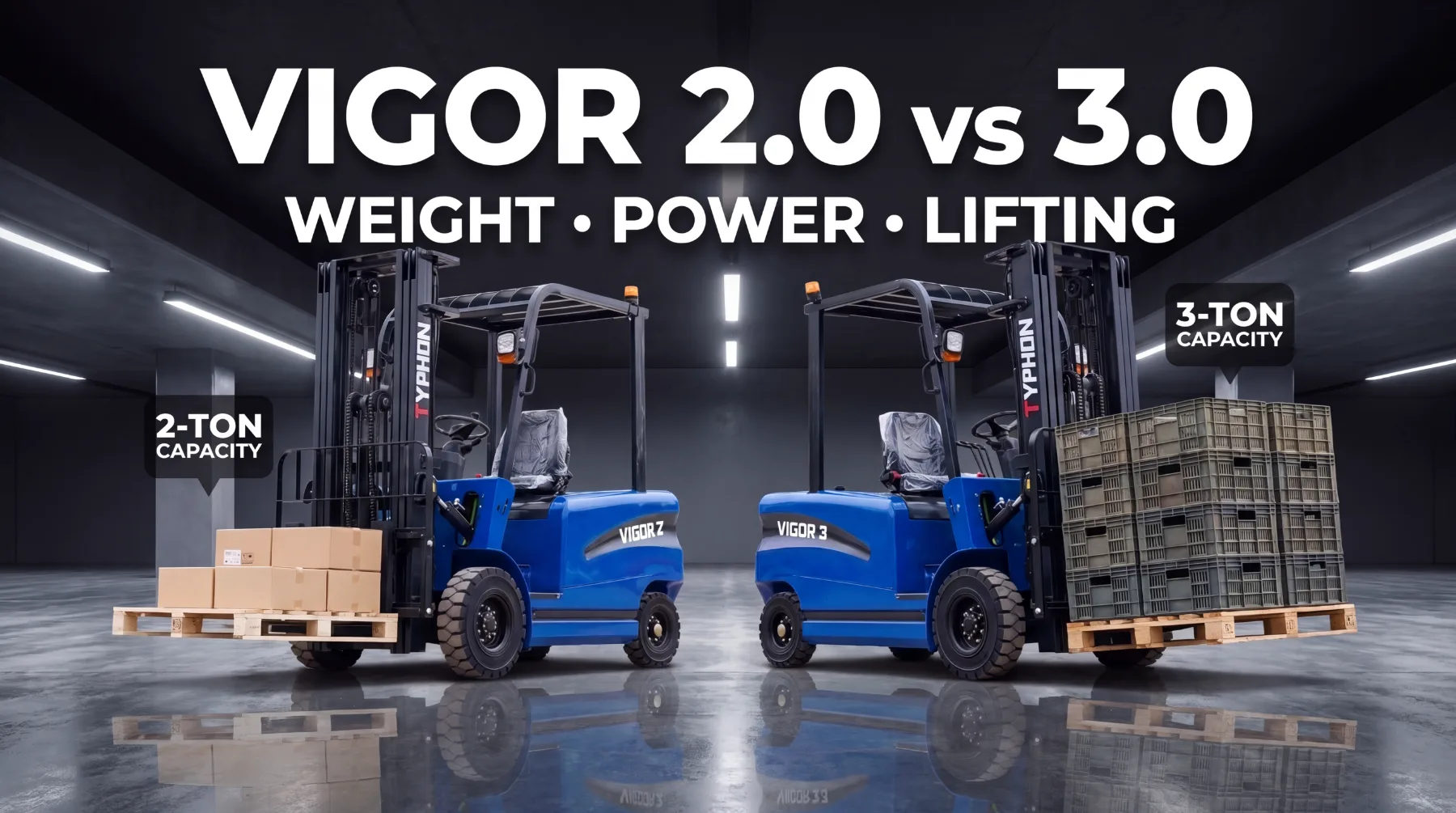
Choosing between the TYPHON Vigor 2.0 and the Vigor 3.0 comes down to matching the right electric forklift to the loads you move and the spaces you work in. Both machines share the same design philosophy: compact, eco-friendly electric forklifts built for low-ceiling indoor work, precise handling, and dependable material movement. Yet they serve different tiers of demand. The Vigor 2.0 is a 2-ton lifter tuned for agility, while the Vigor 3.0 steps up to 3-ton capacity with a heavier, more stable chassis. This guide compares the two models across weight, power, lifting capacity, and stability, then helps you decide which one fits your operation. By the end, you will know exactly what separates these two forklifts and how to choose with confidence.
Weight and Size: How Vigor 2.0 and 3.0 Differ
Operating weight is the clearest physical difference between these two forklifts, and it shapes how each machine behaves in your facility. The Vigor 2.0 weighs 6,170 lbs, while the Vigor 3.0 comes in at 7,500 lbs. That gap of roughly 1,330 lbs is not incidental. It reflects the heavier chassis, larger counterweight, and reinforced structure the 3.0 needs to handle greater loads safely. When you compare the two side by side, you are really comparing a nimble machine against a more substantial one built for heavier work. Size follows the same pattern. The Vigor 2.0 has a truck body length of 2,600 mm (excluding forks) and a width of 1,230 mm, paired with a 1,740 mm wheelbase and a tight minimum turning radius of 2,310 mm. The Vigor 3.0 stretches to a 2,775 mm body length, a slightly narrower 1,200 mm width, a longer 1,950 mm wheelbase, and a 2,530 mm turning radius. These numbers translate directly into how each machine moves through your space. The practical effect shows up in warehouse navigation. The Vigor 2.0's shorter body, shorter wheelbase, and tighter turning radius make it easier to maneuver in narrow aisles, congested storage areas, and tight loading zones. It is the machine you want when floor space is at a premium and every inch of clearance counts. The Vigor 3.0, with its longer wheelbase and wider turning arc, needs a little more room to operate, but that added length and mass support its heavier-duty role. Both models share a compact footprint suited to low-ceiling indoor environments, and both include lateral side-shift capability that lets the operator reposition the fork carriage left or right without moving the entire truck. That feature preserves maneuverability on both machines, but the Vigor 2.0 remains the more agile choice for genuinely confined spaces.
Engine Power and Performance
Both the Vigor 2.0 and the Vigor 3.0 run on the same electrical foundation: a 60V/250 Ah lead-acid battery system. This shared power source is central to how both machines perform, and it reflects TYPHON's decision to build these forklifts around clean, quiet electric operation rather than combustion. For indoor work in warehouses, refrigerated storerooms, and similar enclosed environments, that electric drive is a defining advantage, delivering power without exhaust fumes or excessive noise. The battery specifications are identical across both models, and so is the charging arrangement. Each forklift charges in roughly six hours and then runs for up to ten hours of operation, a duty cycle well suited to a standard shift with time to recharge afterward. Both machines also include a smart charging solution compatible with any 110V charging point, and each ships with its charger included. This means an operator can plug either Vigor into standard facility power without special infrastructure, which keeps setup simple and lowers the barrier to bringing electric lifting into an operation. Where performance differs is in how that shared power is applied. The Vigor 3.0 carries the same 60V system but must move a heavier chassis and lift heavier loads, so its power is working across a more demanding profile. The Vigor 2.0, lighter and rated for lighter loads, has its power spread across a smaller machine, which can translate into brisk, responsive handling in everyday tasks. Neither machine is underpowered for its role; each is matched to the work it is designed to perform. Both forklifts also feature hydraulic steering for precise control and solid rubber tires for durability and stable footing during operation. Hydraulic steering keeps the machines responsive and easy to direct, even when the operator is maneuvering carefully around racking or placing a load into a tight slot. The solid tires resist punctures and hold up well on hard indoor surfaces, supporting consistent, dependable performance shift after shift. Together, the shared battery, charging system, steering, and tires give both models a common performance backbone, with the difference lying in the scale of work each is tuned to handle.
Lifting Capacity and Hydraulic Strength
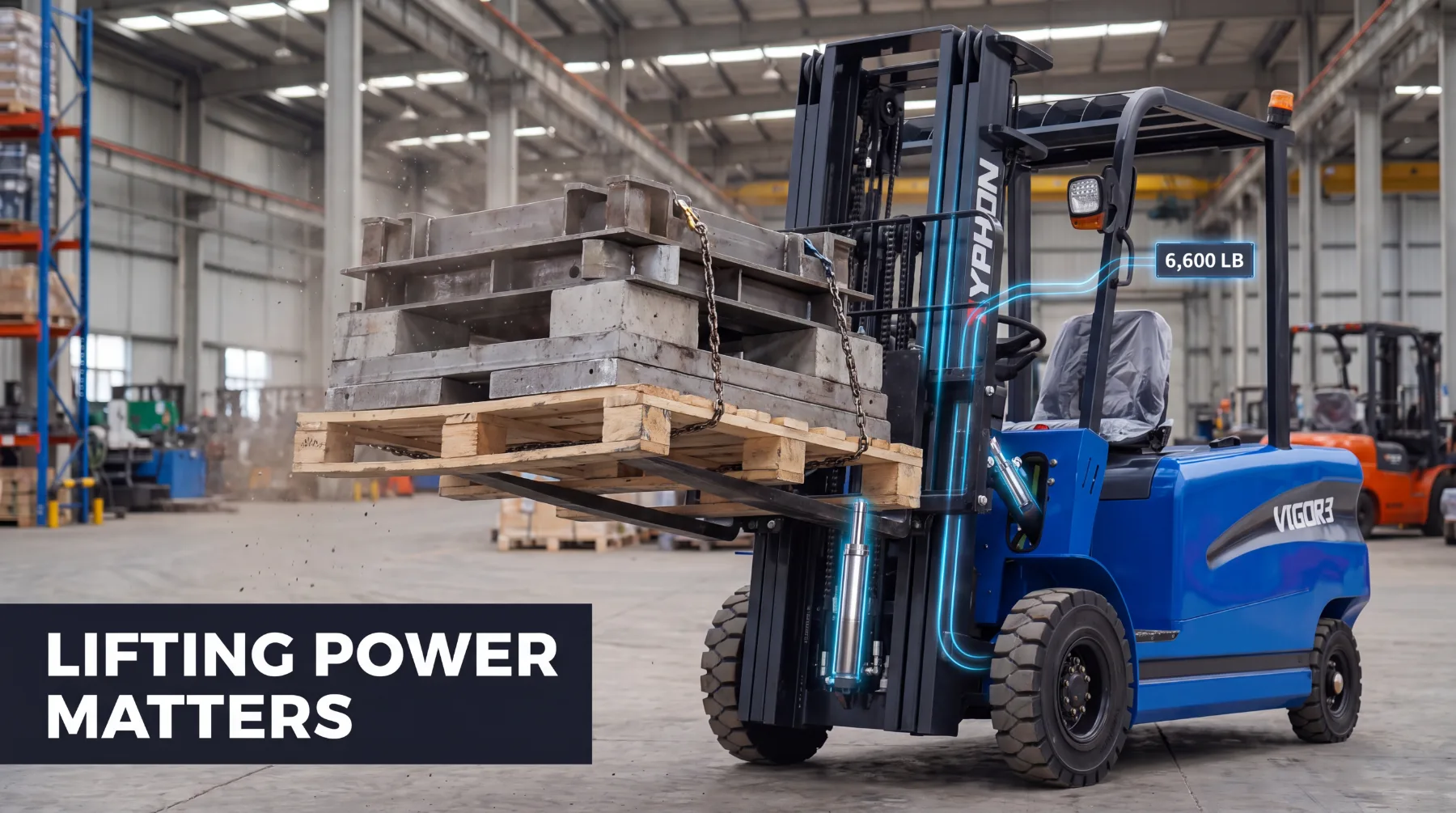
Lifting capacity is where these two forklifts most clearly separate, and it is the specification most likely to decide which machine belongs in your operation. The Vigor 2.0 carries a rated lifting weight of 4,400 lbs, making it a true 2-ton lifter. The Vigor 3.0 raises that ceiling substantially to 6,600 lbs, a full 3-ton capacity. That difference of 2,200 lbs is significant, representing a 50 percent increase in rated load, and it defines the boundary between the two models more than any other figure. TYPHON notes that both machines offer roughly twice the lifting capacity of many comparable forklifts on the market, so even the Vigor 2.0 is a strong performer within its class, while the Vigor 3.0 pushes that advantage further. Both models share the same lifting geometry, which makes the capacity comparison cleaner. Each has a load center distance of 500 mm, a maximum lifting height of 4.5 m, and a three-stage mast that reaches staged heights of 1,600 mm, 3,000 mm, and 4,500 mm. Each also provides 1,400 mm of free lift, a feature specifically valuable in low-ceiling situations where the forks need to raise a load before the mast begins to extend. This means both forklifts can reach the same heights and handle the same low-clearance conditions; the difference lies purely in how much weight they can carry to those heights. The practical implication is straightforward. If your typical loads sit at or below 4,400 lbs, the Vigor 2.0 has the hydraulic strength to handle them dependably while keeping the machine lighter and more maneuverable. If your work regularly involves pallets, materials, or equipment approaching or exceeding two tons, the Vigor 3.0's 6,600 lbs capacity gives you the headroom to lift them safely without straining the machine. Choosing a forklift whose rated capacity comfortably exceeds your heaviest routine load is sound practice, because it preserves a margin of safety and reduces stress on the hydraulic system over time. The Vigor 3.0 provides that margin for heavier operations, while the Vigor 2.0 delivers it for lighter, more agile work.
Stability When Handling Heavy Loads
Stability is closely tied to weight, and here the Vigor 3.0's heavier chassis becomes a genuine advantage. A forklift lifting a heavy load must counterbalance that weight to stay planted and secure, and the machine's own mass is a central part of that equation. At 7,500 lbs, the Vigor 3.0 brings significantly more mass to bear than the 6,170 lbs Vigor 2.0. That additional weight, much of it in the counterweight and chassis, helps the 3.0 remain steady and controlled when hoisting loads near its 6,600 lbs rating. For heavy-duty lifting, that stability is not a luxury; it is what allows the machine to handle demanding loads with confidence. The longer wheelbase of the Vigor 3.0 reinforces this stability. At 1,950 mm compared with the Vigor 2.0's 1,740 mm, the extended wheelbase provides a larger, more stable base of support beneath the machine. A longer wheelbase distributes the machine's weight and the load over a greater distance, which contributes to steadiness during lifting operations. Combined with the heavier chassis, this gives the Vigor 3.0 a solid, planted feel that suits the heavier work it is built for. None of this means the Vigor 2.0 is unstable. Its 1,740 mm wheelbase and 6,170 lbs operating weight are properly matched to its 4,400 lbs rated capacity, so it handles its intended loads with appropriate control and security. The key principle is balance: each machine's weight and wheelbase are engineered to suit its rated capacity. The Vigor 2.0 is stable within its lighter working range, and the Vigor 3.0 is stable within its heavier one. Both models also share features that support controlled handling regardless of load. Solid rubber tires provide a firm, consistent contact with the floor, and hydraulic steering keeps the operator in precise command of the machine's movement. The lateral side-shift function further supports stable load placement by letting the operator align the forks without repositioning the whole truck, reducing awkward maneuvers that could unsettle a load. Where the two diverge is in the ceiling of their stable performance: the heavier, longer Vigor 3.0 is simply built to stay steady under greater weight, which is exactly what heavy-duty operations require.
Choosing the Right Vigor
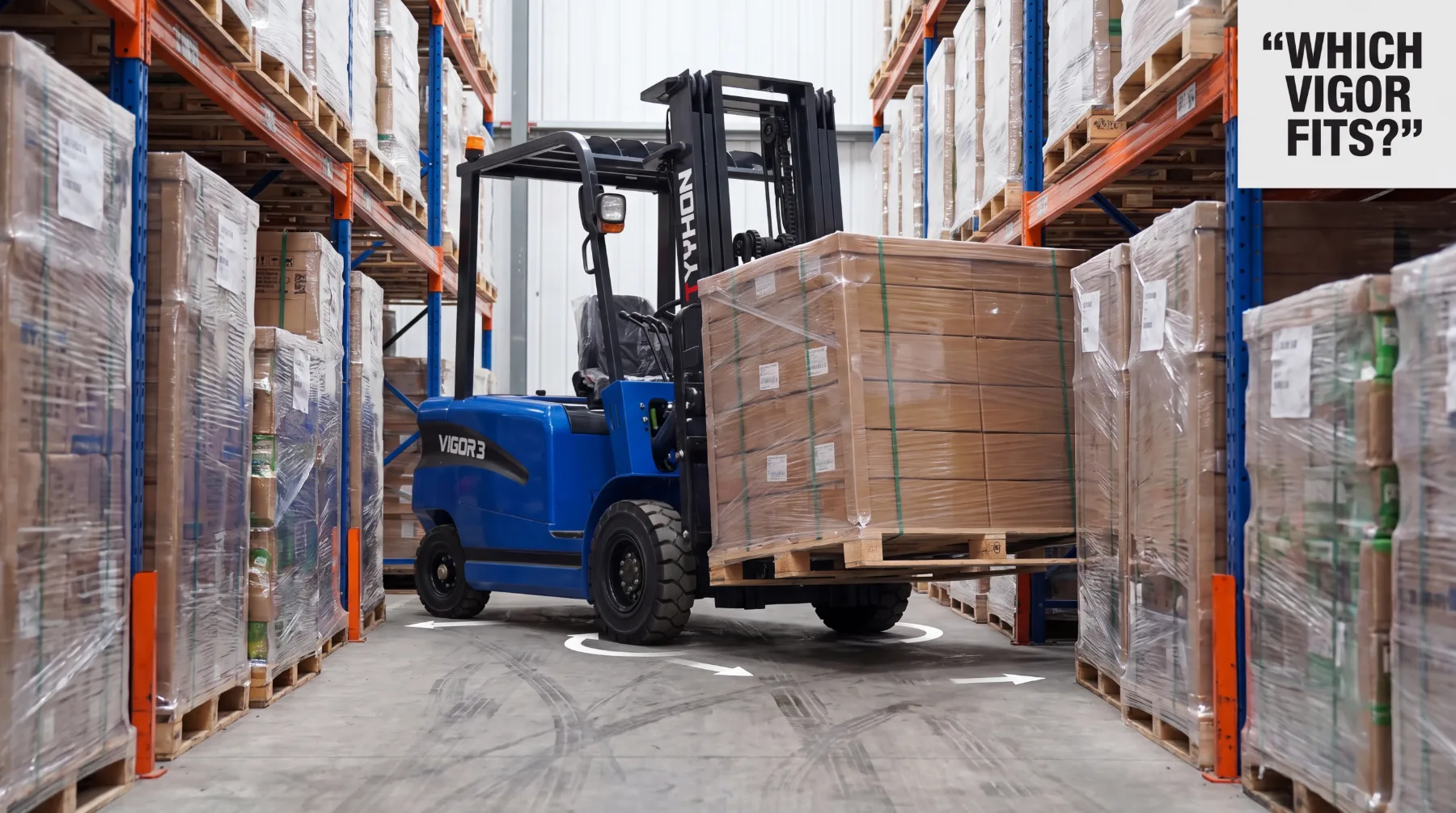
Selecting between the Vigor 2.0 and the Vigor 3.0 comes down to matching the machine to the real demands of your operation rather than defaulting to the larger or smaller model. Two factors carry the most weight in this decision: how heavy your loads are and how much space you have to work in. Weighing these honestly against each model's strengths will point you clearly toward the right choice. Start with load requirements, since capacity is the defining difference between the two. Consider the following:
- Choose the Vigor 2.0 if your routine loads sit at or below 4,400 lbs. Its 2-ton capacity handles lighter pallets, materials, and goods dependably, and its lighter build keeps it agile.
- Choose the Vigor 3.0 if you regularly move loads approaching or exceeding two tons. Its 6,600 lbs, 3-ton capacity gives you the headroom to lift heavier material safely, with a stability margin that lighter machines cannot match.
Space is the second major consideration. The Vigor 2.0's shorter 2,600 mm body, 1,740 mm wheelbase, and tighter 2,310 mm turning radius make it the better fit for narrow aisles, congested storage areas, and facilities where maneuverability matters most. The Vigor 3.0, with its longer body and 2,530 mm turning radius, needs a bit more room, so it suits operations with wider aisles and more open working space that can accommodate its larger footprint. Fortunately, several factors do not force a trade-off, because both models share them. Each is an electric forklift designed for low-ceiling indoor use, each runs on the same 60V/250 Ah battery with a six-hour charge and up to ten hours of operation, and each reaches the same 4.5 m maximum lift height with 1,400 mm of free lift. Both include hydraulic steering, solid rubber tires, side-shift capability, and a smart 110V-compatible charger. This shared foundation means your decision can focus squarely on capacity and space. The dependable approach is to define your heaviest routine load and your tightest working space first, then choose the Vigor whose capacity comfortably covers that load and whose dimensions fit that space. Operations handling lighter loads in confined areas are well served by the Vigor 2.0, while those lifting heavier material with room to maneuver will find the Vigor 3.0 the stronger, more capable partner.
Conclusion
The TYPHON Vigor 2.0 and Vigor 3.0 share a common electric foundation, from their 60V/250 Ah battery systems and six-hour charge cycles to their 4.5 m lift height, hydraulic steering, and solid rubber tires. Where they differ is in scale. The Vigor 2.0, at 6,170 lbs with a 4,400 lbs capacity, brings agility and a tight turning radius to lighter loads and confined spaces. The Vigor 3.0, at 7,500 lbs with a 6,600 lbs capacity and a longer wheelbase, delivers greater lifting strength and superior stability for heavier, more demanding work. Neither model is simply better than the other; each is engineered for a different tier of load and a different kind of workspace. Define your heaviest routine load and your available space, then match the machine to those needs. Choose that way, and either Vigor will reward you with the reliable, efficient material handling TYPHON builds these forklifts to deliver.
Frequently Asked Questions
1. What is the main difference between the TYPHON Vigor 2.0 and Vigor 3.0? The most important difference is lifting capacity. The Vigor 2.0 is a 2-ton forklift with a rated lifting weight of 4,400 lbs, while the Vigor 3.0 is a 3-ton machine rated for 6,600 lbs, a 50 percent increase. This difference is supported by their operating weights, with the Vigor 2.0 at 6,170 lbs and the Vigor 3.0 at 7,500 lbs. The heavier chassis of the 3.0 provides the counterbalance and stability needed to handle its greater loads safely. Both models share the same battery system, charging arrangement, 4.5 m maximum lift height, hydraulic steering, and solid rubber tires, so the decision between them centers largely on how much weight you need to lift and how much space you have to operate in. 2. Do both Vigor models use the same battery and charging system? Yes. Both the Vigor 2.0 and the Vigor 3.0 are powered by a 60V/250 Ah lead-acid battery. Each charges in roughly six hours and then operates for up to ten hours, a cycle well suited to a standard working shift with time to recharge afterward. Both machines also come with a smart charging solution compatible with any 110V charging point, and each includes its charger. This means you can plug either forklift into standard facility power without installing special infrastructure. The identical power source keeps the comparison between the two models focused on their physical differences, chiefly capacity, weight, and dimensions, rather than on their electrical systems, which are the same across both machines. 3. Which Vigor model is better for tight warehouse aisles? The Vigor 2.0 is the better choice for tight or congested spaces. It has a shorter truck body length of 2,600 mm, a shorter 1,740 mm wheelbase, and a tighter minimum turning radius of 2,310 mm, all of which make it easier to maneuver in narrow aisles and confined storage areas. The Vigor 3.0, with its longer 2,775 mm body, 1,950 mm wheelbase, and 2,530 mm turning radius, needs a bit more room to operate. Both models include lateral side-shift capability, which lets the operator reposition the fork carriage left or right without moving the whole truck, helping preserve maneuverability. Still, when floor space is genuinely limited, the Vigor 2.0's more compact dimensions give it the clear edge. 4. Why does the Vigor 3.0 offer better stability for heavy loads? The Vigor 3.0's stability advantage comes from its heavier chassis and longer wheelbase. At 7,500 lbs, it carries significantly more mass than the 6,170 lbs Vigor 2.0, and much of that extra weight functions as counterbalance when lifting heavy loads. A forklift must counterbalance the weight it hoists to stay planted, so more machine mass supports steadier handling of heavier loads. The 3.0's longer 1,950 mm wheelbase, compared with the 2.0's 1,740 mm, also provides a larger base of support that helps keep the machine steady during lifting. This makes the Vigor 3.0 well suited to heavy-duty work near its 6,600 lbs rating. The Vigor 2.0 remains stable within its lighter rated range, since its weight and wheelbase are matched to its 4,400 lbs capacity. 5. How do I decide which Vigor model to buy? Base your decision on two things: your heaviest routine load and your tightest working space. If your typical loads are at or below 4,400 lbs and you work in narrow aisles or congested areas, the Vigor 2.0 offers the right capacity along with a compact, agile footprint. If you regularly handle loads approaching or exceeding two tons and have room to maneuver a larger machine, the Vigor 3.0's 6,600 lbs capacity and greater stability make it the stronger fit. It is wise to choose a forklift whose rated capacity comfortably exceeds your heaviest load, which preserves a safety margin and reduces strain on the hydraulic system. Since both models share the same battery, lift height, steering, and tires, you can focus your choice on capacity and available space with confidence.
Need help turning this research into a real quote request?
Send the machine category, intended use, or product name to the KUVUO team and we can help you take the next step.
Contact KUVUO